Ceramic Typology
Preface
March 2017 - M. Kelly-BuccellatiData overview
Relationship to the Urkesh Global Record
Format
An example
This digital volume on the Urkesh ceramic typology covers all inhabited periods of the settlement, that is from the Late Chalcolithic period, ca 3500 B.C. until the Middle Assyrian period, ca 1250 B.C. It also includes excavated tombs in the Outer City dating to Early Dynastic II and exavations in the Outer City OH2) dating to Early Dynastic III as well as significant surface collections in the Outer City (OD50).
The book is structured so that it serves two purposes. First it presents in an organized and transparent manner the principles behind the analysis of the Urkesh ceramics and the methodology pursued during this analysis. The second purpose is to present the vast amount of data excavated and analyzed during the twenty five seasons of our excavations and study.
Back to top
Data overview
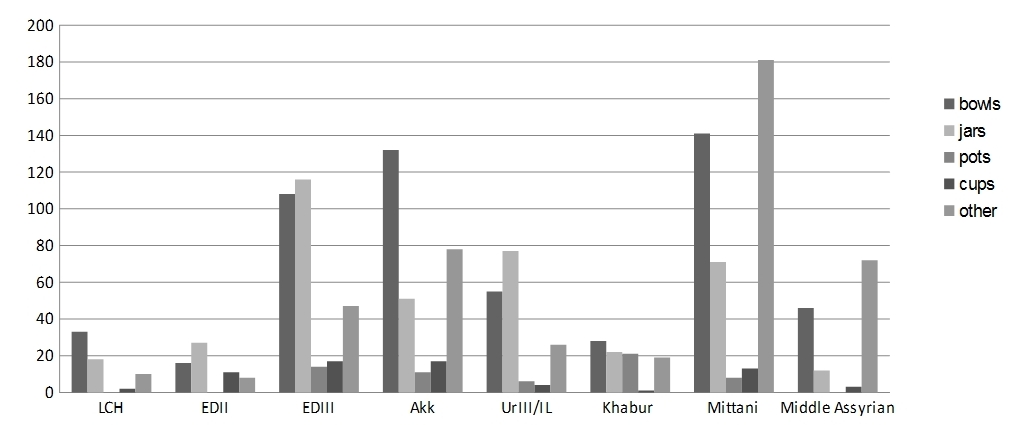
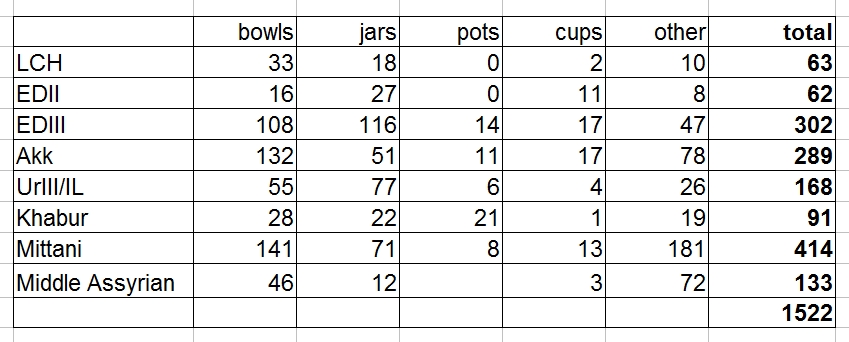
Two charts give an overview of the ceramics presente4d in the book.
The Shapes by Horizon chart presents the totals found in the horizon catalogs which have a total of 1522 items. The chart is broken down by horizon and then by basic shapes of the excavated vessels and sherds.
 |
 |
Back to top
Relationship to the UGR
The book is embedded within the Urkesh Global Record Urkesh website since in this way all the ceramic data is part of the overall record and intrinsically linked to the context in which it was found.
Back to top
Format
As with the other digital books in the Urkesh Global Record (UGR) the format for the Ceramics book is divided into three sections. The central section (b) displays the link called up while the two sidebars contain the structured links. The left sidebar gives in detail the "how" of the analysis while the right hand sidebar shows the "what" that was analyzed in both chronologically based and typologically based formats. The upper left hand side (a1) contains a section on the book as a unit and gives the background to the work including the various collaborators who helped to construct the digital book The Book. Particularly helpful on the Left Hand side is the section on field methodology which explains the steps the ceramic vessels and sherds went through from the initial excavation to the final disposition field methodology. The second section of the left sidebar (a2) contains the categorization system which explains in detail the principles of analysis and the methodology used to apply this system in Mozan. In two major sections this side gives a description of all the terms employed in the analysis: href="../a2/roster.htm">roster and lexicon. The attributes, such as wares wares, shapes shapes, decoration decoration are described while the section on Time Assignment gives an overview of how the chronology of all the ceramics is presented Time Assignment.
The right hand sidebar (c1) presents the ceramic shapes sorted by chronology. While the detailed shape descriptions are found on the left hand side, here the ceramics are categorized by their individual chronological horizons and in sub-categories divided by shapes including overall shape, family, sub-family and type number. Particularly useful is the Cross-horizon typology section Cross-horizon typology. The right hand sidebar has an extensive portion with indicies (c2). These indicies represent only those ceramics found in the chronological section and are sorted by chronology and typology. The tabulations for the individual field books are found on the Left Hand side of those books. See for example tabulations . In the unit books in the UGR the individual items in their original stratigraphic context are shown with the complete description of the that context and an inventory and description of the elements found in the context. This allows the user to go from the highest node (the context in this case) to the lowest node (a single sherd in this case) easily, a characteristic of the entire Urkesh Global Record.
Back to top
An example
To best illustrate this linkage between context and typology the trajectory of a single sherd will be here followed. The sherd chosen comes from a Mittani period deep bowl with a line of painted birds as the decoration. It is from the J1 unit book and was excavated in feature 38. Within this feature it was found in q lot 139 and labeled as p1, the link gives a description of the context, with further links indicated, and a photo and drawing. The shape type drawing for the Mittani period is found in the Mittani horizon catalog. The decoration type is categorized as M6. By clicking on these links the detailed analysis of both the context and the typology can be studied.